Showing posts with label Culture. Show all posts

"Danh Du" - traditional game at Vietnamese village festivals

By  
"Danh du" (Swings) have been traditional game at Vietnamese village festivals for centuries.

The game is most popular in the northern delta, especially along the banks of the Duong River in Bac Ninh Province. Residents in many villages around Hanoi, including the ancient capital of Co Loa, also set up swings during spring festivals.

"Danh Du" - traditional game at Vietnamese village festivals

A Complete History of Dai Viet (“Dai Viet su ky toan thu”) states: "In the Ly Dynasty, in spring or the first lunar month, boys and girls get together and play this game". Villagers usually build their swings on a dry, harvested rice paddy near a communal house. The area should be large enough for spectators to stand around all four sides.

Swings and the associated games come in many kinds and variations. However, the most common Vietnamese swings involve a wooden platform, not a seat. One or two people stand on the platform and swing themselves high in the air, even tens of meters, until their bodies are almost parallel to the ground. Their goal is a prize hanging from the top of the swing's frame.

Playing tools

The frame of the swing is constructed of solid bamboo. The handles are also made of bamboo that is straight, without knots and wide enough for a person's palm. The swing's platform must be close enough to the ground that players can jump on easily.

To ensure safety, builders must choose the right bamboo, for young bamboo is weak, while old bamboo is less elastic and tends to break. They seal their completed frame with paper and invite an elderly villager to check its quality. If the frame meets his standards, he will remove the seal. With that, someone beats a drum. He clasps both hands in front of his chest and bows to his fellow villagers. Then, on behalf of the community, he opens the game.

How to play the game

Players should dress smartly and neatly. Boys wear red purse-belts and girls greenish pulse-belts over traditional four-panel dresses (“ao tu than”) and then headscarves so their hair won't come loose. Often a boy and girl will swing together.

"Danh Du" - traditional game at Vietnamese village festivals1

First, the couple steps onto the swing platform and stands face to face. Then they press their feet against platform floor and bend their knees. Gradually, the swing begins to move like a pendulum. The harder they press, the higher the swing flies, as described in a poem by the 19th-century woman poet Ho Xuan Huong:

“The boy bends his knees
The girl bends her back
The four red panels of her skirt fly in the air
Two parallel lines of stretched legs”

At the height or their swinging, the two almost lie on top of one another. The crowd cheers. As soon as the couple reaches the highest point, one of the two will stretch out a hand and try to snatch the prize. This is the most difficult part of the game, for it requires that both players be calm, clever and acts as a team. They lose if they drop the prize. The crowd is just as anxious, hoping the couple manages to secure the prize as a reward for their long days of practice. There is a note that this type of swinging is not for those who get dizzy!

Let’s once join in the game and you will find it so interesting...

Source: vietnam-beauty.com

Sinh village painting - a kind of folk painting of Hue

By  
Sinh village in Thua Thien Hue province has made folk paintings for the central region for more than 400 years. The paintings are made by farmers during crop intervals. Sinh village has become a popular tourist destination.

Sinh village painting - a kind of folk painting of Hue

Sinh village, also known as Lai An village, is located in Phu Mau commune, Phu Vang district, about 9 km east of Hue city. Sinh folk paintings are somewhat like the Dong Ho folk paintings of Bac Ninh province and the Hang Trong folk paintings of Hanoi. 

Local elders say that the craft of making folk paintings was first introduced in the region by Mr. Ky Huu Hoa during the Nguyen dynasty. The paintings are used for worshiping and other rituals. Woodblocks are used to make the paintings. 

Huu Phuoc is a famous artisan in Sinh village: “Each place has its own tradition and religion. In Sai Gon, they also have votive papers and paintings but they are smaller. 

Sinh votive paintings are now also popular in Ho Chi Minh City because they are beautiful. Sinh paintings are mostly used during the traditional lunar New Year festival and in some special worshipping ceremonies. 

The peak season of Sinh folk paintings is from the 10th lunar month to the following February”.
The woodblocks are used as moulds for color printing. Some other colors are painted by the artists themselves. Therefore, Sinh paintings are always different. 

Each of them reflects the skills and attributes of its author. The colors used are made from natural ingredients like leaves, flowers, vegetables, ashes of rice straws, and brick powder. 

Phuoc says that while Dong Ho folk paintings have just four or five main colors, Sinh paintings have more, limited only by the artist’s imagination: “Sinh paintings are handmade. After printing, we color the paintings. 

Sinh village painting - a kind of folk painting of Hue1

We have to color five times for five colors. The five main colors of Sinh paintings are represent the five elements: metal, wood, water, fire, and earth”.

Papers used to make the paintings are made from clam shells taken from Tam Giang lagoon. The shells are ground into powder, mixed with glue, and then pasted on paper to make shell paper. 

Decorative patterns on Sinh papers vary to appeal to different tastes. Folk games and landscapes are among the main themes of Sinh paintings which are often used to make calendars. 

Visitors to Sinh village can make their own painting, from printing to hand coloring. Le Mai Huong is a tourist from Quang Ninh province: “I come here to learn about the traditional crafts of Hue, especially Sinh paintings. Everything is natural. 

The papers, the color powder are made of natural ingredients.  The process of making paintings is also interesting”.

Each painting is rolled up in a bamboo tube to protect it. The names of the village and the artist are engraved on the bamboo tube. Sinh paintings are the favorite souvenirs of tourists who come to Hue.

Source: VOV

The story of lanterns at Mid-autumn festival

By  
The Mid-autumn festival is an occasion for children to play with traditional toys, especially shadow lanterns and star lanterns.

The story of lanterns at Mid-autumn festival

The Mid-Autumn Festival is held on the 15th day of the 8th lunar month when children are given beautiful star lanterns and shadow lanterns. Alongside these they are gifted clown masks and lion masks for a special evening performance. This year, the festival falls on September 27.
 
Nguyen Van Quyen, who has spent over 70 years making lanterns for children, said the Mid-autumn festival is based on a story of a bear eating the moon-a story which is related to the lunar eclipse.
 
“Based on that story, adults let children play drums and music loudly on this day to drive away the bear,” he explains. “But nowadays, this festival really simply for kids to have fun, and it is also an opportunity to bring them closer to traditional toys and games,” he added.
 
Vietnamese lanterns
 
About a month before the festival, Chinese toys such as battery-powered lanterns, robots, and dolls appear on Ha Noi’s toy street, Luong Van Can.

Hoa, the owner of a toy store, said, “Star lanterns and shadow lanterns go on sale about one or two weeks before Mid-autumn festival. Almost every year, they go out of stock quickly. Although toys that are made in China seem more appealing, many customers still choose to buy Vietnamese traditional toys on this occasion.”
 
Another lantern maker, Nguyen Van Quyen, lives and works in Dan Vien village, about 20 kilometres south of the capital centre. Taking out a shadow lantern from last year’s festival, he describes that it is made of wax paper covering a bamboo frame.
 
A candle inside helps spin propellers, each of which is connected to a paper figure. The shadows of those figures then appear on the wax paper. The spinning propellers cause the movement of the shadows, giving the impression that they are running in a circle inside.
 
The paper figure is replaceable and children can create any figure they like. “People used to make figures of Vietnamese farmers and workers, but now I choose Vietnamese fairy tale characters such as peacocks and water buffalo to bring traditional stories to children,” Quyen shared.
 
The story of lanterns at Mid-autumn festival1

According to the old lantern maker, a myth says that a shadow lantern resents filial piety: “There was a young boy whose father died early and he stayed at home to take care of his sick mother. Worrying that his mother would be sad when he went out to make a living, he invented the shadow lantern so his mother could be entertained by the moving figures. The story spread and it reached the king. After visiting the son’s house, the king was touched and he suggested all citizens make shadow lantern in honour.”
 
Compared to a shadow lantern, the star lantern’s design is much simpler. It is a star-shaped bamboo frame covered with coloured cellophane. “Star lanterns represent the real star that our ancestors wanted to pick from the sky and give to the children. Because there were many stars in the fall, our ancestors came up with the idea of making star lanterns for their children to play with, along with the dragon dance,” said Quyen. “It gives the kids a feeling that they can reach the sky and it therefore encourages them to have big dreams and discover the world.”
 
Past glory
 
“You need to patiently watch the figures and remember the story behind them to know how meaningful it is,” Quyen shares. He adds that when he was small, he had to walk for up to four kilometres to the market and could sell only one or two lanterns. “Farmers in the old time had to work all day so they had little time for such things,” he recalled.
 
Quyen adds that the shadow lantern started becoming popular in the market about 10 years ago. “That was when the Viet Nam Museum of Ethnology invited me to participate in an event regarding the preservation of traditional toys. My role was to teach students to make star and shadow lanterns,” he said.
 
From then on, the amount of lanterns sold has been increasing every year. In 2014, Quyen sold about 200. “I make them mainly because of my love for this tradition. I don’t want it to fall into oblivion,” he shared.
 
A dying trade
 
Not many people want to dedicate their time to this trade because it does not bring much profit. “We make lanterns 100% by hand, with materials bought on Hang Ma street. It takes one whole day to make a shadow lantern, but we can only sell it for VND100,000 (US$4.5). In terms of income, this is not an appealing job,” Quyen explained.
 
The story of lanterns at Mid-autumn festival2

Meanwhile, star lanterns sell very well and they are usually out of stock well before the festival. Each lantern costs around VND10,000, but this barely covers the cost of producing them.
 
“If we increase the price, we cannot compete with Chinese toys. Because we care about preserving this culture more than our income, we keep on going,” said Quyen.
 
Quyen believes that in order to preserve this tradition the authorities and sponsors should work together to organize more traditional events. “We hope that people can see the beauty of traditional games and toys,” she said.

Source: vietnamtourism.com

Traditional culture values are the future of Vietnam tourism

By  
Recently, US online newspaper Huffington Post has posted the article with the title “The future of Viet Nam travel is anchored by deep traditions” written by Tamar Lowell, CEO of Access Trips tour operator in Washington State (USA). 

Traditional culture values are the future of Vietnam tourism/

Tamar Lowell said that Viet Nam is a name that stirs the senses and emotions. It conjures visions of proud farmers in conical straw hats tending their rice paddies. It conjures smells of lemongrass, ginger and mint, savory spices used in Vietnamese cooking. It conjures the romance of a bygone colonial era, and the hope of a resilient people who look to a modern future, even as they retain the exotic culture and deep traditions of their ancient past.

Tamar Lowell’s article was begun like that. Tamar traveled to Viet Nam and her greatest feelings are exciting, even mesmerized by Viet Nam.

Traditional culture values are the future of Vietnam tourism.,

From an early age, Tamar read everything she could on Viet Nam, watched every movies, and even participated in a course in college on French and American Indochina wars. So when the USA and Viet Nam normalized the diplomatic relation in 1994, Tamar immediately planned a trip before her graduation. In July 1994, she was among the first Americans to visit Viet Nam after the war.

Tamar vividly remembers the day she arrived in Sai Gon, the overwhelming wave of excitement. The city looked exactly as she pictured it. The Vietnamese (particularly the Southerners) are very outgoing, although they knew that she’s an American. She can't profess to understand how or why the Vietnamese people were able to move on, despite having lost. In all her time in Viet Nam, she has never, not once after that first day, been uncomfortable about being an American.

Traditional culture values are the future of Vietnam tourism

“I have always been treated graciously, kindly, and warmly. I was scheduled to stay for two weeks, but the following day I extended my stay to a month. It was not always an easy trip, but it was incredible, and life-changing in so many ways. I was about to start my first job in the travel industry, and I vowed I would one day come back to Viet Nam to work.”

Over the past two decades, Tamar always watched Viet Nam embrace rapid change while still retaining its distinct character, longstanding traditions, and the warmth and openness of its people.

Since that first trip, 20 years passed and now she is a director of a tour operator, which has just launched a culinary tour to Viet Nam. Her tour highlights the experience of culture, cuisine from the North to the South, creates opportunities for visitors to visit UNESCO world heritage sites (Complex of Hue Monuments, Hoi An Ancient Town…) and connect with villagers, urban hipsters, street food, vendors, artists, allowing them to experience the evolution of complex and rich Vietnamese culture.

Traditional culture values are the future of Vietnam tourism1

“The first time I was there, Viet Nam was very much a communist country in name and in practice, and the service levels, or lack thereof, reflected it. I clearly remember thinking that this country had so much to offer visitors, but they needed to get their act together and understand what Westerners expected service-wise, or people would not come. Well, they did just that. Tourism to Viet Nam has grown almost six-fold over the past twenty years, and the service we experience now in hotels, in restaurants, and in stores, is excellent. Unlike other developing countries, you are not bombarded by hawkers on the street - approached, yes, but respectfully. In taxis, if you tell them you want to use the meter, they turn on the meter, no hassle. I'm so inspired by both the individuals I've met in Viet Nam, and by the resilience and spirit of the society as a whole.” Tamar said.

At the end of the article, Tamar Lowell stressed, “The country is moving forward, but the charm remains: in the beautiful old buildings; the hanging silk lanterns; the women who still wear traditional cone hats, not because they're iconic, but because they are functional; and in the kindness and warmth of the locals. It is truly amazing how Viet Nam tourism has evolved in the last twenty years, without losing its soul or its character.”

Thu Giang - vietnamtourism.org.vn

A Hanoi Haircut: street style

By  
I have an extremely close relationship with my coiffure. I used to have long thick locks of hair that I wore in a sort of white mans afro like Bob Dylan in his prime. Although I have recently tamed my mane, it is still a focal point of my vanity.

A Hanoi Haircut: street style

Due to this reality, I have put off getting my hair cut for the past two months that I have been in South East Asia. Unable to ignore the growth anymore, I decided to face my hairish dilemma and am currently sitting on a wooden bench, on the sidewalk of Ta Quang Buu, waiting for my turn to get a street hair cut.

At the moment there is an elderly grey-haired Vietnamese man sitting underneath a tarp on a makeshift barbers chair. With anticipatory interest, I watch the middle age street barber with thick black hair and a facemask carefully scissor away. 

The barber has propped a mirror on the wall in front of the elderly man and utilizes a basket for his hair tools, amongst the clippings strewn clay tiled sidewalk. The only electronic tools he has are a trimmer and a vacuum, both plugged into an extension chord precariously perched on the wall under the mirror.

The elder gentleman got up and paid - a common interaction that I always watch closely to avoid being ripped off - and I plopped down in the barber’s chair. I separated the thumb and forefinger of my right hand to communicate the amount of desired shearing and he started cutting my hair at full speed.

As clumps of my hair rained down on my shoulders and the surrounding sidewalk, I decided to keep my eyes closed for two reasons. First, I always close my eyes during haircuts, a necessity to take in the full relaxation that can be gleaned from such an activity. Second, I did not want to look dissatisfied with his craft because after the initial plunge I had no concrete way to orchestrate a barber about-face.

In mere minutes, the snipping ceased and he began to vacuum my head and shoulders. He then suctioned over my ear, startling me and pulling my eyes open. I peeked into the cracked mirror on the wall and was pleasantly surprised by my new do, which was only slightly too short for my liking.

Now that my eyes where open I was able to observe the intricate comings of goings of Ta Quang Buu from a truly special vantage point. He finished his swift job by placing a new blade in his old fashioned straight razor and eliminating my rat-tail and unsightly neck hair. VND30,000 ($1.50) lighter, I gleefully walked down the street, paid a cobbler VND10,000 ($0.50) to reattach a portion of my loafer’s sole and headed home.

The street barbers, like all aspects of the vibrant street scene in Bach Khoa, Hanoi, vary in quality and price. They may not be able to handle everyone’s coif but for guys visiting or living in Hanoi, experiencing a street cut is a must. After all, there really is nothing similar to visually consuming the busy streets of Hanoi from a barber’s chair on the sidewalk.

Randolph Lovelace III (VOV)

Discover Cai Luong music (renovated opera)

By  
Cai Luong (Renovated Opera) appeared in the southern part of Vietnam in the 1920s. This relatively modern form combines drama, modeled after French comedy, and singing.

Discover Cai Luong music (renovated opera)

Scenes are elaborate and are changed frequently throughout the play. Cai luong is similar to the Western operettas and more easily depicts the inner feelings of the characters. Songs of the Cai luong are based on variations of a limited number, perhaps 20, of tunes with different tempos for particular emotions – this convention permits a composer to choose among 20 variations to express anger, and as many to portray joy.

The principal supporting songs in Cai Luong is the Vong Co (literally, nostalgia for the past). Cai luong owes much of its success to the sweet voices of the cast, much appreciated by the audience. Upon hearing the first bars of the well-loved Vong Co, the audience reacts with gasps of recognition and applause.

The Cai luong performance includes dances, songs, and music; the music originally drew its influences from southern folk music. Since then, the music of Cai luong has been enriched with hundreds of new tunes. A Cai luong orchestra consists mainly of guitars with concave frets, and danakim.

Over the years, Cai luong has experienced a number of changes to become a type of stage performance highly appreciated by the Vietnamese people as well as foreign visitors.

Source: vietnam-culture.com

Family life values in Vietnam

By  
In Vietnam, family is a basic social unit of the society. Vietnamese family life is profoundly influenced by ancestor worship. Children learn at a very early age that they owe everything to their parents and their ancestors. When children do well in school and work hard, they honour their parents and the family name. Respect for parents and ancestors is extended to all elders, whose life experiences are valued.

Family life values in Vietnam

Marriage and family are very important in Vietnam. In the countryside, parents often arrange marriages; divorce remains uncommon, though is more frequent in cities. In traditional Vietnamese families, roles are rigid. The man of the house is primarily responsible for the family's economic well-being and takes pride in his role as provider. Women are expected to submit to their husbands or to their eldest sons when widowed, and girls to their fathers. Older children help to look after younger siblings. Discipline is viewed as a parental duty, and spanking is common once children are past early childhood.

The woman of the house is referred to as noi tro, "General of the Interior." She looks after her in-laws as well as her parents, husband and children. In rural areas, women also do much agricultural work. Vietnamese women live by the "four virtues": hard work, beauty, refined speech and excellent conduct.

Communism in the 1960's brought big changes for women, who were suddenly given equal economic and political rights, as well as the right to choose their own husband. Years of warfare and dislocation in camps have also altered family roles. With so many men away at war, women took on many traditionally male duties, including managing factories and co-operatives.

Today, more and more people are moving to cities, but most Vietnamese are still farmers. Houses are sometimes built on stilts to avoid flooding. Materials such as earth, straw and bamboo may be used for walls, and red clay tiles or sheets of corrugated metal for roofs. City homes are often made with brick, wood and/or tile.

Source: vietnamtourism.org.vn

Doan Ngo festival

By  
"Doan Ngo Festival”, also called “Tết giết sâu bọ” (translated as Festival for “Killing the persons’ inner insects”), is the second most significant festival (to the Lunar New Year Tet Holiday) of Vietnam. 

Doan Ngo festival

What does these names mean?   Literally, Tet refers to festival, Doan means the start, Ngo is the seventh animal of the Chinese zodiac- the horse. Doan Ngo festival is also known as Tết sâu bọ (sâu bọ = worms, pests) or Tết tháng 5, to be celebrated on the 5th day of the 5th lunar month.

The name “Tet sau bo” derives from the fact that farmers, on this day, get rid of all pests to start growing their crops for the new season. Therefore, creatures and people must become stronger in both their health and their souls to overcome this. On this occasion, the whole family have to get up early and eat fermented sticky and fruits. The worshipping is held at noon, hour of Ngo. The tradition of eating dumplings, especially lye water dumplings, extends from the belief that the dumplings will cleanse one’s body of any unwanted “parasites”.

Two irreplaceable dishes   

The two traditional types of food to be eaten on this holiday are banh u and com ruou. Banh u is pyramidal sticky rice cakes wrapped in banana leaves. They are often stuffed with beans and banana leaves’ essence, creating its dominant flavor.

Com ruou, which literally translates as “rice wine,” are little balls of fermented rice bathed in wine. Com ruou is associated with the myth telling that a long time ago, there were two orphan brothers living together in a small village. They were popular among the locals for their intelligence and kindness. Also, in that village, there were two snakes Thanh Xa and Bach Xa, which after long lives, turned into spirits.  Falling in love with the brothers, they transformed themselves into beautiful ladies to lure the men. Their desire soon became true, Thanh Xa got married the older brother and Bach Xa the younger.

Doan Ngo festival,

They lived happily together until the men grew unhealthy each passing day, scared of daylight and lived in festering darkness. The locals suspected the presence of a bad spirit, and one day, luckily, a Taoist hermit passed by the village. After being told the affliction, he conducted some spirit type tests and found out that the men’s house had a case of the evils. Brewing a wine potion, he told the locals to feed it to the men. The brothers must eat the potion’s solids and liquids in the early morning of the next fifth day of the fifth lunar calendar.  As soon as the men tucked into their special breakfast, their wives were turned into their real appearance of snakes, before disappearing in a puff of smoke, freeing the brothers.  Since that day, people have eaten “ruou nep” on Killing the Insect Day, in the hope of driving away bad spirits.

The process of making Com ruou is not quite complicated but time-consuming.  In order to have good com ruou in Doan Ngo Festival, the famers must harvest the reaped rice from a paddy, dried and pounded carefully to keep the most nutritious part of the rice. At first, the rice is steamed twice for about 30 minutes and left for a while to get cool. After that, It is mixed with yeast, before being left for two or three days to ferment, depending on the weather.  Com ruou is eaten early on this day to fight the “worms” in one’s stomach.

Just try it, you will see that Com ruou brings you a strong and quite delicious taste. In the Vietnamese traditional concept, com ruou can kill any parasites in the body. Vietnamese people, from adults to kids, mostly like eating com ruou, yet, adults are more inclined to gain its curing effects with a grain of salt.

Up to now, besides the Lunar New Year Holiday, Doan Ngo Festival plays a significant role in every Vietnamese life for practical and holy meanings. Enjoying the atmosphere of Doan Ngo Festival, you will get to know more about its value and spirits.

Source: vietnam-beauty.com

Discover culture of Mong people

By  
Mong minority ethnic group in the northern upland province of Son La celebrates the New Year a month earlier than the country’s traditional Lunar New Year, or Tet. 

Discover culture of Mong people

When mist and freezing temperatures pervade the northern upland, young native people start the spring festival with many folk games and activities such as bamboo flute blowing, pa pao pillow throwing, spindle, tug of war and dragon hatching.

Local women make various kinds of cakes from corn and rice flour like banh day (round sticky rice cake) or men men cake, while the elderly gather to drink corn wine, visit one another and extend good wishes on New Year’s Day, according to a report by VietnamPlus.

Mong people have unique culture and rich spiritual life, characterized by their costume and cultural activities. Their clothes look very colorful and come with multiple forms that are traits and characteristics of Mong people.

Giang Khanh Ly, a resident in Van Ho District, is quoted by VitenamPlus as saying that the costume of a woman can reveal many interesting things about her group. White Mong women wear white skirts, V-necked shirts with embroidered patterns in the arms and shirt tails. They usually have their hair shaved, except for the top tuft, and wear a wide turban. Black Mong wear indigo black dresses with printed wax patterns and V-necked shirts.

Discover culture of Mong people /

Meanwhile, Variegated Mong prefer indigo blue dresses with embroidery or printed wax patterns. The shirt is cut at the armpit while the shoulder and chest are covered with colorful fabric and embroidery. They have long hair rolled with horsehair wigs.

Green Mong decorate their clothes with colorful pieces of cloth and embroidery motifs simulating snail, square, diamond and cross shapes. As for menswear, the highlight is the broad green pants and a white turban around their head.

Especially, the life of Mong people is closely connected to the pan-pipe crafted from six bamboo tubes and a wooden gourd. This musical instrument plays an important role in their spiritual life. Previously, it was used to invoke the spirits of the dead to guide them to their forefathers and relatives. However, it is now used at festivals and other traditional events and especially men play it to express love to girls.

The pan-pipe is considered a cultural symbol of the Mong ethnic group as artists can use it to create a wide range of melodious tones.

In joyous occasions like the New Year holiday, people will sing songs with cheerful tunes depicting labor, life, love and friendship. Girls in their new dresses holding colorful umbrellas dance to the music.

Currently, some 130,000 Mong people in Son La live in Bac Yen, Moc Chau, Van Ho, Thuan Chau, Mai Son, Yen Chau, Song Ma and Sop Cop mountainous districts, accounting for 13% of the province’s population.

Source: SGT

Nam Giao Esplanade in Hue

By  
Right after being crowned (1802), Emperor Gia Long built the esplanade in An Ninh village in 1803. A few years later, the Court left that position and had new terraces built in Dương Xuân village in the south of Huế Citadel (the remains have been preserved).

Nam Giao Esplanade in Hue/

The Esplanade construction commenced on 25th March, 1806. In early 1807, Gia Long’s Court organized its first worship of Heaven ceremonies (Tế Giao ceremony) there.

Nam Giao Esplanade is an open-air monument. The model of architecture bears both the religious and political significance of Oriental feudalism. Nam Giao Esplanade is connected with the Confucian dogma of heaven. Nam Giao Esplanade also shows the concepts derived from ancient thoughts on the universe: circular heaven and square earth.

Nam Giao Esplanade faces south. Its surrounding stone wall has four big open doors acing the four directions. In front of each door is a very big screen (12.5 meters wide, 3.2 meters high and 0.8meters thick). During Tết holidays, big flags with various colors hung on all these doors: black flag on the north door, blue on the east, red on the south and white on the west.

Nam Giao Esplanade has three terraces of diminishing size in its structure, sumbolizing the oriental theory of three agents: Heaven, Earth and Man. Each terrace had its own color and significance: circular heaven, square earth, blue heaven, yellow earth. The topmost called Viên Đàn is circular, symbolizing Heaven. The surrounding parapet is painted blue. On the day of the ceremony, people built on this layer a conical tent with blue cloth called Thanh Ốc. The next below is a square terrace called Phương Đàn, representing the Earth. The surrounding parapet is painted yellow. For the ceremony, a square house with yellow cloth roof smaller than the one above called Hoàng Ốc was built. The lowest layer is square. The surrounding parapet is painted red, symbolizing Man. At this year, 128 students and dancers performed during the ceremony. The three layers are 4.65 meters high in total. The architecture of Nam Giao Esplanade followed the principles of Yin and Yang and the five basic elements (Metal, Wood, Water, Fire and Earth).

Nam Giao Esplanade in Hue

From Gia Long’s time (1802-1819), the ceremony was annually organized in the first weeks of the second month in the lunar calendar (March of the solar year). From 1880, Emperor Thành Thái realized that each ceremony was too costly so he decided to organize it once every three years. It took the Protocol and Administration Ministries months to prepare for the ceremony. For each ceremony, the emperor came to the Fasting Palace (Trai Cung) to stay there for three days prior to the ceremony. In Bảo Đại’s time, the duration was reduced to one day. The emperor came from the citadel (Đại Nội) to Trai Cung accompanyied by a procession including from 1,000 to 5,000 people. The king sat on the sedan-chair (Ngự Liễn) carried by royal soldiers in the middle path. The main ceremony began officially at 2a.m. and lasted nearly 3 hours.

All the sacrificial offering terraces of the Lý, Trần and Lê Dynasties (from the 11th to 18th centuries) no longer exist. Nam Giao Esplanade of the Nguyễn Dynasty is the only one left relatively undamaged. Visiting it, tourists can have an opportunity to understand more about many aspects of the cultural and spiritual life of Vietnamese feudalism.

Source: vietnamnow.org 

Uncle Teu in the Water puppet show

By  
Uncle Tễu is an introductory character but also the most important among the water puppets. We might call him the soul of the water puppets and the source of sympathy between the performers and the audience. Tễu is the character properly beloved in both the imperial palace and the village.

Uncle Teu in the Water puppet show

In reality, Tễu is larger than the other puppets, although a main character, he is a youngster of seven or eight judging from the way his hair is cut in tufts. He is stout, fat, with a rosy complexion and a closely shaved head or a scarf. His body is unclothed, his chest and belly flabby, his face always cheerful and his eyes sneaking looks to one side, then the other. Tễu wears a buttonless loin cloth exposing his belly and chest. His hands swing, showing his elbows, and his head turns from one side to the others as he watches the audience. His appearance is one of taunting and teasing.

Uncle Teu in the Water puppet show1

Chú Tễu (there are those who call him Tễu because of the Chinese-Vietnamese character Tễu meaning “laughter”) is a reckless, jesting character who mocks and jokes. Chú Tễu is the person who introduces the beginning of the performance as the commentator, critic, lover of tales, and opposition to corrupt officials when he follows his duty in the role of clown mocking western theater. In some guilds, Tễu raises the flag or lights the firecrackers. Others see Tễu as a kind of village crier, who offers his services to the elderly; slaughters pigs, water buffalo and oxen; and whose wife is beautiful and enticing.

Uncle Teu in the Water puppet show.

All guilds have Tễu enter first to recite one or two introductory speeches. As in Greek theater, there’s discussion between the audience and performer that begins in this way:
“So?” Tễu says. “Rush in. Have you a choice?”

Tễu’s introductory speeches differ among the guilds.

Source: hanoinay.com

Pan-pine - A unique musical instrucment

By  
Legend has it that a poor young man named Lo went missing from his village. After some time his friends went to look for him and finally found him, dead by a stream with a Khen Be in his hand. 

Pan-pine - A unique musical instrucment

In his memory, his friends made copies of his Khen Be. Since that time, young Thai men have carried theses with them day and night.

A Khen Be looks a little like a large scale mouth organ or pan pipe, but with a single cross pipe/ sound box, into which you blow to create the musical notes. The sound comes from tiny swinging reeds inside the bamboo tubes, with the notes changing by closing the holes on the tubes.

The Khen Be of the Thai people consists of fourteen small thin bamboo tubes, arranged together and decreasing in height with one end connected to a sound box. It is divided into two layers, each consisting of seven bamboo tubes. The sound box is made of wood, with the one end hollow for blowing into and the other sealed with max. 

Whereas the Hmong Khen Be comprises only four hallow bamboo tubes attached to a sound box. The overall size of a khen be is determined by is maker, while the sound is dependent on the type of reeds used. These are usually made of bronze of silver, are as thin as paper, and are attached inside the bamboo tubes. Circular tones holes are made in the sound box. 

Thus the tone, pitch and range of the instrument depend on its reeds and the distance between the holes. A Khen Be with a long loud low-pitch is commonly used by old people at home, while a shorter low and high-pitched one is used by young people.

Pan-pine - A unique musical instrucment.

Lo Van Nhoi, a famous khen be artisan says, “A good Khen Be  while being played, should reveal its player’s and the maker’s innermost feelings.” Behind the severity and hardness of mountain living, the people are simple and quiet souls, and filled with the aspiration to be at one with nature.

The Khen Be is used in many difference aspects of daily life such as celebrations like the Lunar New Year festival, ceremonies to welcome guests and weddings. Its sound is seductive, whether it is played wild and fast or slow and gentle. The ethnic minorities use the Khen Be as an accompaniment to folk-songs and dances in their traditional festivals and when celebrating other significant events.

The music of the Khen Be has become an instrument of seduction used by young men to convey message and woo young women. When a young man knows how to hold and use a knife and hoe correctly to work in the field, it is also time for him to play the khen be well. 

The people learn how to play the khen be not only to entertain, but also to show off their talents and help them to find their life partners. Young men of strong build who can play alluring khen be melodies easily win young women’s hearts.

Source: VOV

Vietnamese traditional Paper fan

By  
Besides seven prized objects in every household listed as a gourd bowl, a quill pen, a Ty Ba (four-string guitar), an orchid, a chess-set, a sword and a feather-duster, the paper fan in Vietnamese tradition was an indispensable items in days of yore. Today, the traditional paper fan is still widespread and familiar in daily life of Vietnamese people, especially in traditional art performances.
The famous paper fan-making village in Vietnam is Thach That in the northern province of Ha Tay (now part of Hanoi).

Vietnamese traditional Paper fan

Fans are of course common throughout the East. But what makes Vietnam's decorative fans of the hand-held variety different from those made in China or Japan is the angle: in the latter countries, fans typically open to more than 180 degrees, whereas Vietnam's are less than 180. If you look into Vietnamese fans, you can imagine it like a sun shining.

Part of what makes these fans art pieces are the paintings and drawings on the surface, which typically include the traditional Han Nom characters, the country's original script, for Heaven, Land and People, which, combined, are said to symbolise prosperity.

Vietnamese traditional Paper fan.

The most important parts of each fan were its two main slats, which form its frame. The material for these slats must be the strongest and most elastic bamboo possible.

The surface of a fan is made of Do paper, derived from bamboo, and silk. Once finished, the surface is then painted, usually using a mixture of dark red, black, yellow, brown and violet - all colours seen in ancient fans.

Nowadays, Vietnamese paper fan is used not only in dailylife but also in traditional art performances because in the past, paper fan is an indispensable decorative item in royal life. Paper fans represent a living tradition for an ancient and beautiful art form.

Source: vietnamtourism.com

Vietnamese traditional Ceramics and Pottery

By  
Pottery has taken form early in Viet Nam. According to ancient document, pottery appears in Viet Nam ten thousand years ago. Following information is general outline of pottery and ceramics appearance through historic development. 

Prehistoric Age

In prehistoric times, ceramic products were understandably coarse as most were mixed by women from sand and other materials. Most of the designs on the surface of the ceramics were created with sticks while the products were still wet. All of the pottery products from this era had useful applications for household duties and cooking.

Bronze Age

Vietnamese traditional Ceramics and Pottery

Most of the pottery products from the Bronze Age were formed on turn tables and had diverse styles. As well as cooking utensils, there were also artistic ceramics and products for tool production.

The diverse products were decorated with carved images and covered by a different coloured layer of an enamel-like substance. The adornment of pottery products from this period was performed using bronze tools.

Iron Age

Iron Age pottery products developed in all regions of the country. These products were produced at low temperatures using somewhat rudimentary techniques. The form and ornamentation of the Iron Age pottery products was quite unique to this period. This craft developed from traditional experience, and from the influence of the Chinese.

Architectural pottery, including bricks and tiles, also originated during this time and small simple statues of animals, such as pigs and oxen, were introduced.

From Ly Dynasty until now

Vietnamese traditional Ceramics and Pottery.

After more than ten centuries of Chinese domination, the Ly and Tran dynasties saw the reestablishment of national independence. During this period, pottery experienced splendid achievements in quality and diversity through large-scale production.

Basic elements, including the form, decorations, and coloured enamel, were employed to create beautiful products. The painted decorations were simple, but incredibly attractive. Unique carving characteristics developed and various kinds of enamel were applied.

Since the 15th century, ceramic started to bear white enamel with blue designs and fabrication techniques improved.

Nowadays, some localities are still specialized in producing ceramics, including Bac Ninh Province, Thanh Hoa Province, Nam Dinh Province, and Ha Noi.

Source: Vietnamtourism.com

Vuong Palace - a symbol of the past

By  
Built in 1914, the palace passed 2 major wars: the French War and the American War. As such, Vuong Palace is also treated as a symbol of the past glory of the H’mong people. In fact, the palace was also called Vua Meo in honor of the king of the H’mong ethnic people.

The Vuong Palace located in Dong Van Plateau, province of Ha Giang has been a well-known tourist destination for several years now. A century-old mansion and once home to an influential family headed by a powerful don in the 20th century, it also was recognized as a national cultural heritage by the government in 1993.

Vuong Palace - a symbol of the past

Built in 1914, the palace survived 2 major wars: the French War and the American War. As a result, Vuong Palace is also treated as a symbol of the past glory of the H’mong people. In fact, the palace was also called Vua Meo in honor of the king of the H’mong ethnic people.

Vuong Chinh Duc led Vuong family from 1865-1947 in an empire stretching as far as from the province’s Dong Van Plateau to Meo Vac Town. The massive production and cross-border trade of opium back then made him the richest and most powerful man in the area. To protect his reign, that’s when he built the Vuong Palace. Covered an area of 1,120 square meters in Sa Phin Commune, Dong Van District, the mansion was designed with Chinese architecture and interior and surrounded by 700 century-old trees to keep it hidden and protected from enemies.

Vuong Palace took eight years to build. With  200 skilled construction workers from China’s Yunnan province (bordering Vietnam) labored on the massive residence which became home to the king, his three wives and four sons. The palace cost 150,000 silver coins to make, or an equivalent of VND150 billion (US$7.5 million) today.

Vuong Palace - a symbol of the past.

Vua Meo (the other name for Vuong Palace) looks very similar to royal residences in China during the Qing Dynasty three to four centuries ago with its stone, valuable wood, terracotta tiles and two-story structure. The living room has a horizontal lacquered board engraved with Chinese characters given by the king of the ruling Nguyen Dynasty then. Each 64 rooms of the palace is decorated with carvings of dragons, phoenixes and bats, symbols of strength, royalty and respectively.

Vuong Palace is also notoriously dubbed the “Opium Palace” because the whole place is filled with stone or wood engraved with poppy flowers and fruit patterns. In fact, the underground cellar on the left side of the mansion was designed purposely for storing opium. Other cellars in the palace were used to store food and weapons. In the backyard of the palace is a half moon-shaped stone bathtub where Chinh Duc’s first wife bathed in goat’s milk. According to local legend, Vua Meo (King Chinh Duc) forced local officials to give him goat every month to get milk for his wife’s bath. Around the palace is a big garden wherein the royal family planted pears, peaches and different kinds of fruit trees.

King Vuong Chinh Duc died in 1947, then his second son Vuong Chi Sinh took over the reign of the empire and dedicated the rest of his life fighting the French. Untill now, surviving members of the Vuong family still live near the area, working as caretakers and tour guides of the historical Vuong Palace.

Source: vietnam.com

Traditional Vietnamese Dress for Men

By  
The special features of the national Vietnamese dress for men have been preserved through the ages. Vietnamese man is proud of wearing this dress because it is part of Vietnamese nation, their history and their culture in general. Moreover, it is part of Vietnamese social customs which includes respect for superiors, dignitaries and relatives. In the past, the people who wore different traditional dresses also showed their status in Vietnamese society.

Traditional Vietnamese Dress for Men
A revived interest in the national Vietnamese dress for men was demonstrated at an Lions International Club meeting held in Tokyo in 1969. The assembled Lions, along with thousands of Japanese observers on the streets and perhaps millions more at their television sets, were treated to a look at the Vietnamese national dress worn by the Vietnamese Lion delegates.

This was the first time Vietnamese men have worn their national dress at an international gathering since the fall of the late President Diem in November 1963. Before that time it was not unusual for Vietnamese diplomats to appear at official functions in their national attire. In Tokyo, however, the "fashion models" were private business men, delegates to the Lions meeting.

Anyone who has seen the exquisite costumes worn by Vietnamese women will recognize similarities in the traditional dress of the male. Both costumes are tailored from the same fabric, worn with the conventional snug collar and buttoned down on the left side to the waist, with no crease in front or back. The male dress extends only to the knees. The female dress flows with graceful lines from a tight waist down to the heels.

Traditional Vietnamese Dress for Men.
The national Vietnamese dress has preserved its essential features through the ages. Vietnamese take great pride in wearing this dress for it is part of their nation, their history and their culture. It is part of Vietnamese social customs which includes respect for superiors, dignitaries and relatives. Elders in the family continue to receive this recognition as did once emperors, mandarins and court teachers, all of whom had traditional dress variations according to their status in Vietnamese society.

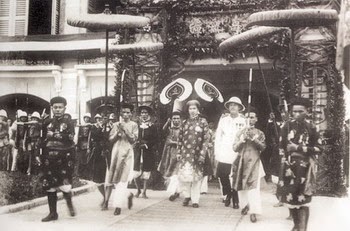
There are many variations on the basic theme. At the top of the list is the elaborate dress of the emperor and the mandarins. Their rank was shown in the display of color in the brocade and embroideries. Gold brocade with embroidered dragons was for the emperor only. Gold is the national color and the dragon heads the fabulous mythical animal world. Purple is the color reserved for high-ranking court mandarins, while blue is for those of lower rank.

Costumes worn for religious ceremonies also have their special colors. Dresses for ceremonial occasions usually have very wide and ample sleeves. Wedding dresses are similar to the popular fashions, and the color is usually purple or blue brocade. Dresses for mourning have frayed fringes or a line up the back and may be either black or white in color.

Traditional Vietnamese Dress for Men
Vietnamese dress styles underwent changes since the beginning of French influence in the country. Many Vietnamese employed by the French had a tendency to look down upon those who continued to wear the traditional dress. European styles were popular mainly among civil servants and university students. The majority of people, especially those in the rural areas, remained faithful to their national dress and it even became a symbol of silent opposition to French colonialism. During the colonial war against the French from I945 to I954, many people concealed their social status. The revolutionaries wore black, those who were pro-French wore western clothes while others wore the simple pajama-type shirt and trousers. Following independence the traditional dress came back into its own and was once again the required attire for all ranking officials at government ceremonies or functions of the diplomatic corps.

When President Diem was overthrown in 1963, the national dress was so closely identified with his administration that it sank with him into oblivion. This neglect, however, was not officially inspired but rather a reflection of political turmoil, frequent government changes and resulting chaos. Today, there is serious thought to restore the Vietnamese national dress for men to its traditional and rightful place, for it is a symbol of pride in the cultural heritage of an ancient and proud Asian land.

Source: vietnamtourism.org.vn